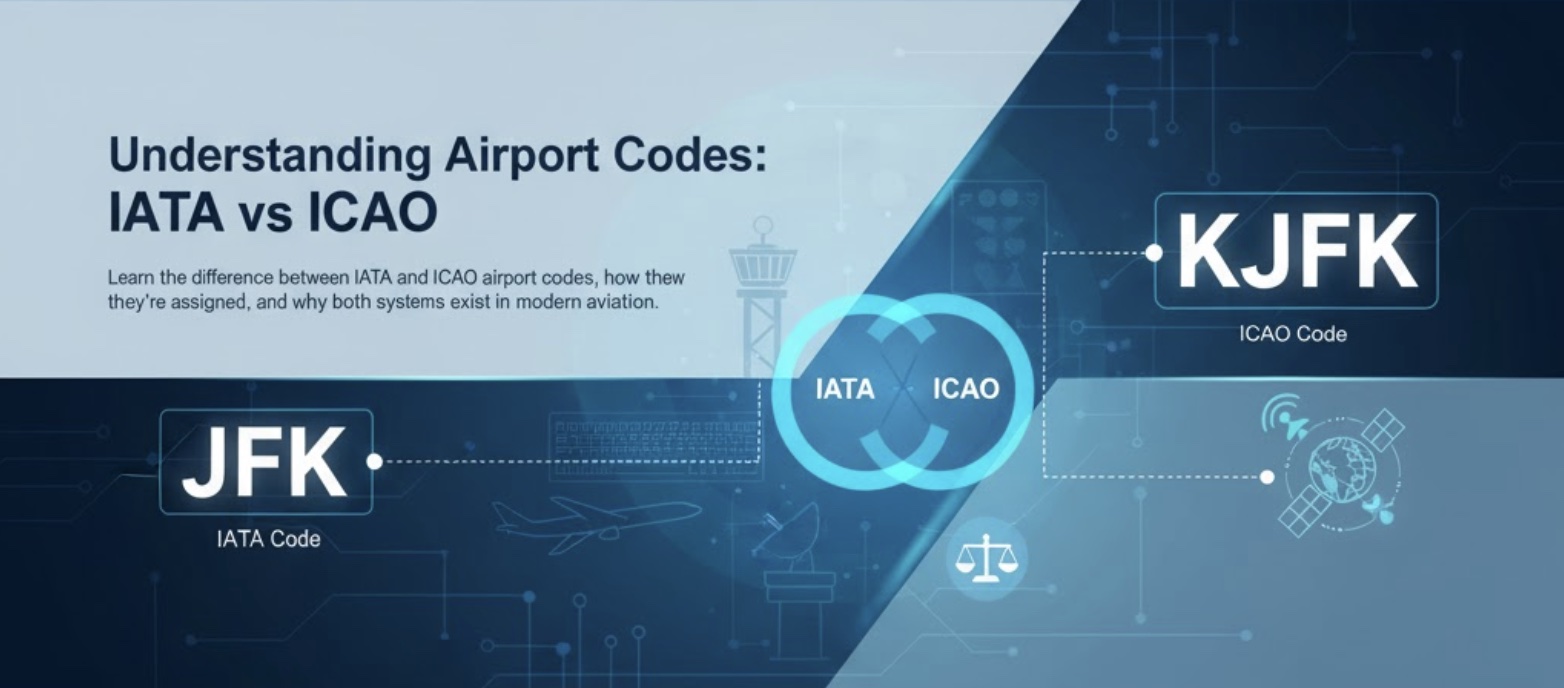
Understanding Airport Codes: IATA vs ICAO
If you’ve ever booked a flight or looked at your boarding pass, you’ve encountered airport codes. But did you know there are actually two different coding systems used in aviation? Let’s explore the fascinating world of airport identifiers.
What Are Airport Codes?
Airport codes are unique identifiers assigned to airports worldwide. They serve as a standardized way to identify airports in flight schedules, baggage handling, air traffic control, and countless other aviation operations.
IATA Codes: The Passenger-Friendly System
What is IATA?
The International Air Transport Association (IATA) is a trade association of the world’s airlines. IATA codes are the three-letter codes you see on your boarding pass and flight information displays.
Examples of IATA Codes:
- LAX - Los Angeles International Airport
- JFK - John F. Kennedy International Airport
- LHR - London Heathrow Airport
- NRT - Narita International Airport (Tokyo)
- CDG - Charles de Gaulle Airport (Paris)
How IATA Codes Work:
- Always 3 letters
- Designed to be memorable and passenger-friendly
- Often based on the city name or airport name
- Used primarily for commercial aviation and passenger services
ICAO Codes: The Technical Standard
What is ICAO?
The International Civil Aviation Organization (ICAO) is a United Nations agency that sets international aviation standards. ICAO codes are used primarily by air traffic control and flight planning systems.
Examples of ICAO Codes:
- KLAX - Los Angeles International Airport
- KJFK - John F. Kennedy International Airport
- EGLL - London Heathrow Airport
- RJAA - Narita International Airport (Tokyo)
- LFPG - Charles de Gaulle Airport (Paris)
How ICAO Codes Work:
- Always 4 letters
- First letter(s) indicate the region/country
- More systematic and globally standardized
- Used primarily for air traffic control and flight planning
// Example: Parsing ICAO codes by region
const parseICAOCode = (code) => {
  const regions = {
    'K': 'United States',
    'C': 'Canada',
    'EG': 'United Kingdom',
    'LF': 'France',
    'RJ': 'Japan'
  };

  for (let prefix in regions) {
    if (code.startsWith(prefix)) {
      return regions[prefix];
    }
  }
  return 'Unknown region';
};

console.log(parseICAOCode('KLAX')); // "United States"
console.log(parseICAOCode('EGLL')); // "United Kingdom"- More systematic and technical approach
- Used by air traffic control, flight planning, and weather services
Regional Patterns in ICAO Codes
ICAO codes follow geographic patterns that help identify regions:
North America
- K* - Continental United States (KLAX, KJFK)
- C* - Canada (CYYZ for Toronto Pearson)
- M* - Mexico and Central America
Europe
- E* - Northern Europe (EGLL for Heathrow)
- L* - Southern Europe (LFPG for Charles de Gaulle)
Asia-Pacific
- R* - Western Pacific (RJAA for Narita)
- V* - South Asia (VHHH for Hong Kong)
- Y* - Australia (YSSY for Sydney)
Other Regions
- F* - Africa
- S* - South America
- O* - Middle East
Why Two Systems?
You might wonder why we need two different coding systems. Here’s why both exist:
IATA Codes Are For:
- Passengers - Easy to remember and recognize
- Marketing - Airline schedules and booking systems
- Baggage - Luggage tags and tracking
- Commercial operations - Ticketing and reservations
ICAO Codes Are For:
- Air Traffic Control - Precise identification in radio communications
- Flight Planning - Navigation and route planning
- Weather Services - Meteorological reports
- Technical Operations - Maintenance and operational records
Interesting Facts
Code Conflicts and Solutions
- Some airports have IATA codes that don’t match their ICAO codes
- When cities have multiple airports, creative solutions are needed
- Some famous airports “bought” their codes from smaller airports
Special Cases
- YYZ (Toronto Pearson) - The “Y” prefix is a Canadian convention
- ORD (Chicago O’Hare) - Named after the original Orchard Field
- SIN (Singapore Changi) - Sometimes codes are surprisingly straightforward
Reserved Codes
- Certain letter combinations are reserved for special purposes
- Some codes are retired and never reused
- New airports must work within the existing system constraints
Using Airport Codes Effectively
For Travelers:
- Learn the codes for your frequently visited airports
- Use IATA codes when booking flights
- Check both codes when researching airports online
For Aviation Professionals:
- Understand both systems for comprehensive communication
- Use ICAO codes for technical and operational purposes
- Be aware of regional patterns for quick identification
The Future of Airport Codes
As aviation continues to grow globally, the challenge of assigning meaningful codes becomes more complex. Both IATA and ICAO continue to evolve their systems to accommodate new airports while maintaining the integrity of existing codes.
The dual coding system, while sometimes confusing, serves the aviation industry well by providing both passenger-friendly identifiers and technical precision for safe operations.
Want to explore airport codes in action? Visit our interactive airport map at airport.ayamap.com to see both IATA and ICAO codes for airports worldwide.